Want to discover the Castries Aqueduct as a family during your stay at Camping Fondespierre? Its impressive stone arches make a lovely destination for a walk just outside the campsite. To enjoy the outing with children, choose a route that suits their walking habits and allow plenty of time for breaks.
In spring, summer or autumn, this walk combines heritage and garrigue landscapes. Here is some useful information to help you plan your visit, from setting off at Fondespierre to taking care near the Cadoule.
At a glance
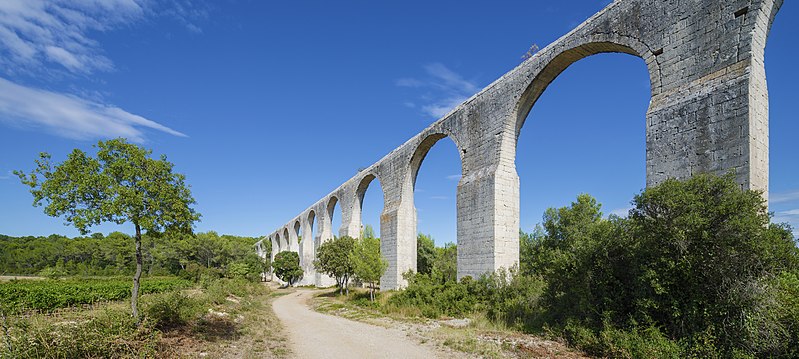
As you arrive near the Grands Arcs, children can look up at a succession of arches rising above the vegetation. Built from local stone, the structure was completed in 1676 to carry water to the park of the Château de Castries.
Designed by Pierre-Paul Riquet, it stretches for nearly 7 km between the Fontgrand springs in Guzargues and the château. Part of its course runs underground, so the visible arches are only one section of the aqueduct.
Before setting off, give the children a little riddle: how could water travel such a long distance without a pump? The ground slopes very gently between the spring and the château, allowing the water to flow by gravity.
A walking route starts at the Fondespierre departmental estate, chemin de Fondespierre, north-east of Castries. From the village, take the D610 towards Restinclières and Sommières. The estate car park is the starting point for the aqueduct route.
From the car park, the walking route guide directs you around the farmhouse along the track on the right, then along the path between cultivated fields and vineyards. After an avenue of plane trees, a junction offers views of the château and the above-ground section of the aqueduct. The shorter alternative then follows a track along the edge of a pine wood towards the first arches.
If you would rather explore without aiming for a particular distance, you can also walk part of the route and return the same way, staying on open paths. Decide on a turning point before you set off, and adjust it to suit how tired the younger children are.
The official walking route guide suggests a shortened loop of 6.5 km, estimated at around 2 hr 10 min, not including breaks. It takes you alongside part of the aqueduct before reaching the Pont des Tourilles area.
This is still a proper hike for young children. The route includes a crossing of the D26 and a crossing of the Cadoule using stepping stones. After rainfall, or if the water level makes the crossing uncertain, do not attempt it: turn back along the path you came on.
The loop around the aqueduct is approximately 11 km and takes 3 hours of walking, according to the tourist information. It passes near the Capelette, a small chapel in the area, then continues to the Pont des Tourilles and the village of Castries before returning to Fondespierre.
It is better suited to families whose children are already used to walking several kilometres. Allow more time than the estimated duration so you can admire the arches, have a snack and take breaks. Download the route guide or track before setting off: it will be more useful than simply checking a map.
These seasons are ideal for a daytime walk, but keep an eye on the weather. Bring a light extra layer for changes in temperature and shoes that fit securely. After rain, the paths can be slippery and the Cadoule may be more difficult to cross.
It is best to set off early in the morning to avoid the hottest part of the day. Bring enough water for everyone, hats and sun protection: do not count on there being shade throughout the route.
Before heading out into natural areas, check the Hérault préfecture’s forest fire risk map. Depending on conditions, access to certain areas may be discouraged or prohibited. Always follow signs and any closures posted on site.
Keep children close to you near roads and water. Stay on accessible paths, do not climb onto the aqueduct and take your rubbish with you. For toddlers, a baby carrier may be more practical than a pushchair on sections of trail; above all, choose a distance that is comfortable for your family.
The tourist office states that visiting the aqueduct is free. Stay on open paths and observe any local restrictions.
The 6.5 km alternative is estimated at around 2 hr 10 min, and the full 11 km loop at around 3 hours. With children, allow extra time for breaks and looking around.
The loops can be long for younger children. Walking part of an open path and returning the same way lets you adjust the distance, while families used to walking can consider the 6.5 km alternative.
Take care: the paths may be slippery, and the crossing of the Cadoule using stepping stones may become impassable. If the crossing is not safe, do not attempt it and turn back.
During your stay at Camping Fondespierre, you can plan this exploration of Castries’ heritage at your own pace: a short walk to admire the arches, or a longer hike for children who enjoy walking.